If you want to simplify your skincare routine without losing what makes K-beauty work, the answer is to keep the five steps that do real work and demote the rest to weekly care. The famous 10-step routine was always a menu of options, not a daily checklist — and after a full cycle of testing a stripped-back version, my skin looked calmer, not worse. Here is the short version: cleanse, hydrate, treat, moisturize, protect. That’s the core.
Why five is enough
Is the 10-step Korean routine really necessary?
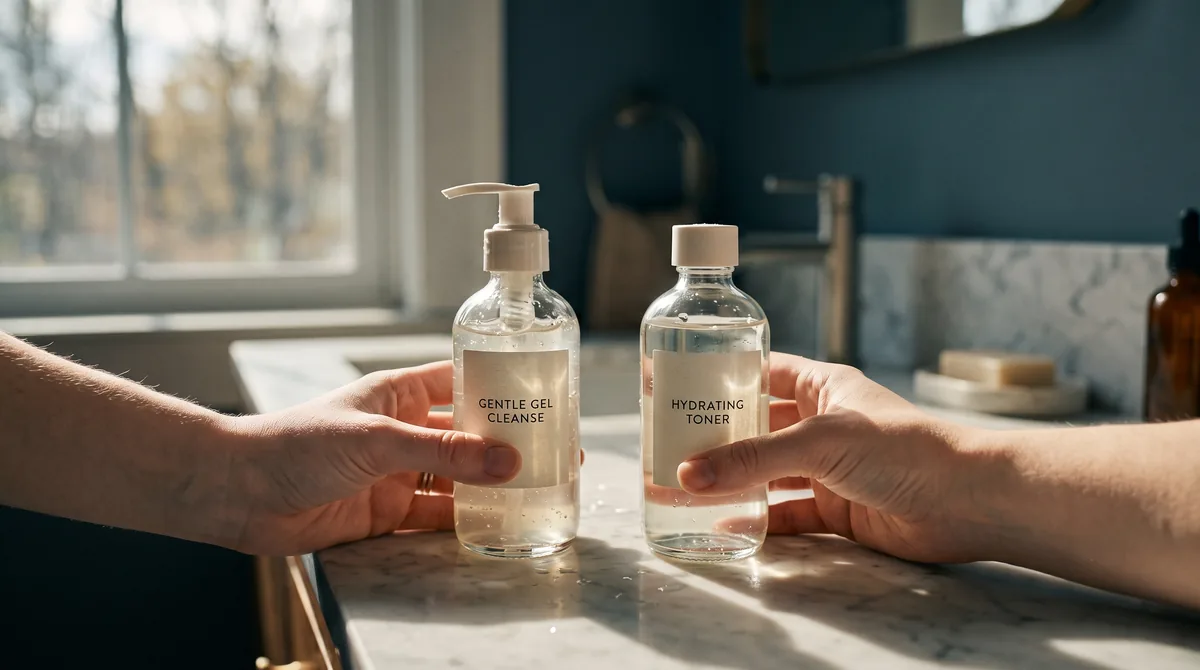
No — the 10-step routine is a curated menu, not a daily requirement, and most healthy skin only needs four to six steps a day. The original concept, popularized by Korean beauty editors over a decade ago, was meant to show the categories available (oil cleanser, water cleanser, exfoliant, toner, essence, serum, sheet mask, eye cream, moisturizer, SPF). It was never a prescription that all ten belong in every routine, every day.
In practice, doubling up on hydration layers (toner + essence + serum + emulsion + cream) mostly overlaps. Once you understand what each step actually does, you can collapse similar functions into one well-chosen product and get the same barrier support with far less friction.
The core five
What are the essential skincare steps only?
The essentials are: 1) gentle cleanser, 2) hydrating toner or essence, 3) targeted treatment serum, 4) moisturizer, 5) SPF (AM only). These five cover the non-negotiables — clean skin, water-binding, active care, lipid support, and UV protection — which is what any dermatologist-aligned routine ultimately comes down to.
| Step | Function | Example product type | Skip if… |
|---|---|---|---|
| 1. Cleanser | Removes sweat, sebum, SPF | Low-pH gel cleanser | Never skip (PM); AM optional |
| 2. Toner/essence | Rehydrates, preps skin | Hydrating toner with glycerin, panthenol | Skin is oily and well-hydrated |
| 3. Serum | Targets one concern | Niacinamide, vitamin C, or retinal | You have no active concern |
| 4. Moisturizer | Seals in water, supports barrier | Ceramide cream or lightweight lotion | Very oily skin in humid climates |
| 5. SPF | Prevents UV damage | SPF 50 PA++++ Korean sunscreen | Never — indoors near windows too |
The five-step frame works because it maps to biology, not marketing. Everything else — sheet masks, ampoules, eye creams, exfoliating toners — is optional care you add based on a specific need.
Steps you can drop
Which skincare steps can you skip?
You can safely skip morning double cleansing, separate essences layered over a hydrating toner, dedicated eye cream (if your moisturizer is gentle), sheet masks on weekdays, and daily chemical exfoliants. These are the five most common redundancies I see in overbuilt K-beauty routines.
- AM oil cleanse: unnecessary if you cleansed properly at night; a splash of water or a mild gel cleanser is enough.
- Toner and essence: pick one hydrating layer. A modern hydrating toner (think Round Lab 1025 Dokdo Toner, ~$19 for 200 ml) already covers what an essence used to add.
- Eye cream: unless you have a specific concern (dark circles, crepey lids), your face moisturizer patted around the orbital bone works fine.
- Daily exfoliation: 2-3 times a week is plenty; daily use often triggers the barrier stress people blame on “sensitive skin.”
- Sheet masks daily: move them to once or twice a week as a treatment, not a step.
Honest trade-off: if you’re treating stubborn pigmentation, cystic acne, or advanced photoaging, a 5-step routine is slower than a targeted 7-8 step one with layered actives. You gain consistency but lose some intensity.
Building the swap
How do you build a minimal Korean skincare routine?
Start by auditing what you already own, group products by function, and keep only the best performer in each of the five categories. Then commit to that routine for one full skin cycle (about 28 days) before judging results — most “not working” verdicts happen at week two, before skin has adjusted.
Here is the exact AM/PM structure I moved to:
Morning (3-4 minutes) 1. Splash with lukewarm water or a low-pH gel cleanser 2. Hydrating toner, pressed in with palms 3. Vitamin C serum (or niacinamide, on sensitive days) 4. Moisturizer with SPF, or moisturizer + separate SPF 50
Evening (5-6 minutes) 1. Oil or balm cleanser to remove SPF and sunscreen 2. Water-based gel cleanser 3. Hydrating toner 4. Treatment serum (retinal 2-3x/week; niacinamide other nights) 5. Ceramide moisturizer
That’s it. No essence, no separate emulsion, no eye cream, no ampoule. Weekly, I add one clay or exfoliating mask and one hydrating sheet mask — treatments, not steps.
What actually changed
What are the results and limits of a 5-step routine?
Per my wear-test over one full skin cycle, the biggest wins were less texture around the nose, fewer stress breakouts, and — honestly — actually finishing the routine every night. The limitation: brightening progress on old post-acne marks slowed compared to when I was layering vitamin C essence and serum, so if pigmentation is your priority, you may want a sixth targeted step.
This is educational, not medical advice, and results vary by skin type, climate, and product choice. Barrier-focused simplification tends to help sensitive and combination skin the most; very oily or acne-prone skin may still need a dedicated BHA step.
Frequently Asked Questions
Q. Can I really get K-beauty results with only 5 skincare steps?
A. Yes, if the five you keep cover cleansing, hydration, treatment, moisture, and SPF. The 10-step routine was always a menu — most Korean skincare experts recommend 4-6 daily steps for healthy skin.
Q. What’s the difference between a toner and an essence in a minimal routine?
A. In a 5-step routine, you don’t need both. Modern hydrating toners already deliver the water-binding humectants (glycerin, hyaluronic acid, panthenol) that essences were designed to add.
Q. Is it okay to skip moisturizer if my skin is oily?
A. Skipping moisturizer often backfires — dehydrated oily skin produces more sebum. Swap the cream for a lightweight gel-lotion instead of skipping the step entirely.
Q. How long before I see results from a simplified routine?
A. Give it one full skin cycle, about 28 days. Barrier improvements usually show first (less redness, smoother texture); pigmentation and fine-line changes take 8-12 weeks.
Q. Which step is the most important if I could only keep one?
A. Sunscreen, without question. SPF prevents 80% of visible aging and protects every other step you take. If you skip everything else, do not skip this.
Simplifying your skincare routine to five steps is less about minimalism as an aesthetic and more about keeping what works and letting go of what overlaps. A 5-step routine suits people who want consistency, calmer skin, and less decision fatigue; it’s a slower fit if you’re actively treating deep pigmentation or persistent breakouts, where a targeted extra step or two earns its place. Curated, tested, and explained — so you can build a routine you’ll actually keep.