Here’s the short version: niacinamide benefits are real but modest — it’s a barrier-friendly multitasker, not a miracle. For most readers, a 2-5% niacinamide serum used once or twice daily is the version that actually works, and it plays nicely with the rest of your routine.
What it does
What are the actual niacinamide benefits for skin?
Niacinamide is a form of vitamin B3 that supports ceramide production, calms visible redness, and helps regulate sebum. In plain terms: it makes the barrier feel steadier, the T-zone less shiny, and pores look a bit smaller over time.
Per published cosmetic-science reviews, it’s one of the few actives with evidence for barrier support, oil control, and tone evenness in the same molecule. That’s why Korean formulas lean on it so heavily — it fits almost any routine without the sting of stronger actives.
Realistic timeline: expect subtle change over 8-12 weeks of consistent use. Anything faster is usually the moisturizer doing the heavy lifting, not the niacinamide.
The right percentage
What’s the best niacinamide percentage — is 10% better than 5%?
For most skin, 2-5% is the sweet spot. It’s the range with the strongest safety record and enough activity to see the benefits above.
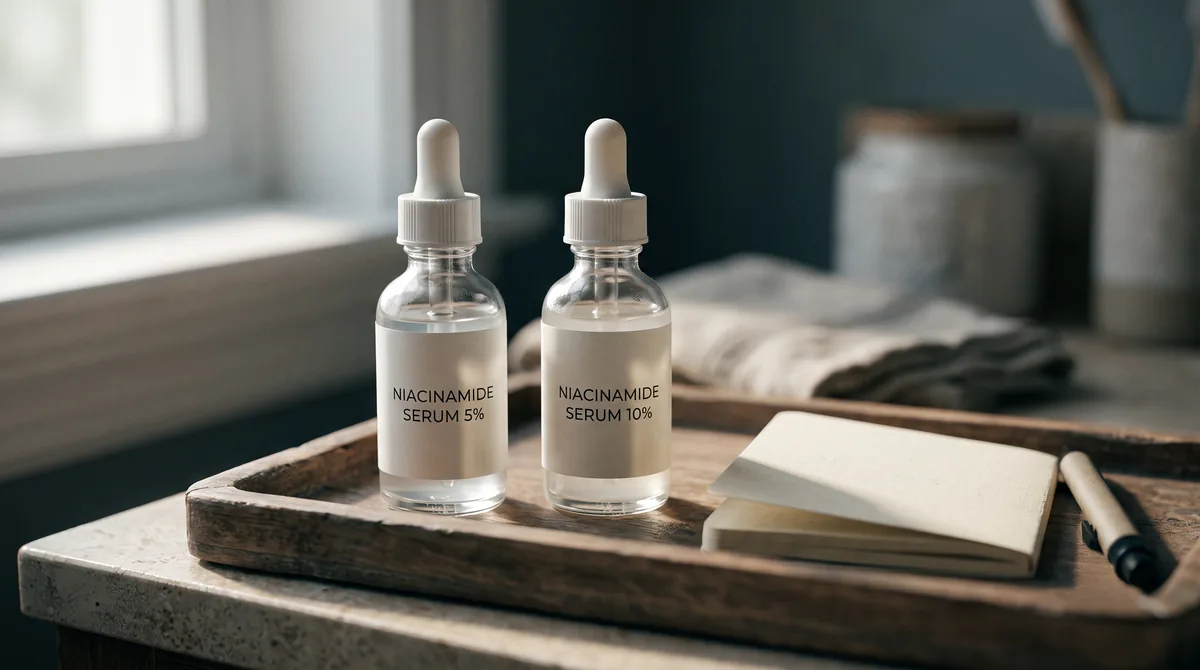
Here’s a quick comparison of common tiers you’ll see on Korean and global shelves:
| Percentage | Best for | Trade-off |
|---|---|---|
| 2% | Sensitive, dry, or barrier-compromised skin | Slower visible change |
| 5% | Most skin types, oily-combo, beginners | Balanced — the safe default |
| 10% | Resilient, oily skin focused on pores/sebum | Higher risk of flushing or irritation |
Going above 10% rarely adds benefit and raises the chance of a warm, pink “niacin flush” — harmless but uncomfortable. If a product doesn’t disclose the percentage, assume it’s in the 2-5% range, which is fine for daily use.
Routine placement
How do you use niacinamide in a Korean skincare routine?
Apply niacinamide after your toner/essence and before your moisturizer, on damp skin, morning or night. In the classic K-beauty order, it sits in the “serum” step — thin texture in, richer texture on top.

A simple, non-fussy routine that actually works:
- AM: gentle cleanser → hydrating toner → niacinamide serum (2-5%) → moisturizer → SPF 30+
- PM: cleanser (double cleanse if you wore SPF/makeup) → toner → niacinamide serum → moisturizer
You don’t need a 10-step routine to get the benefit. If budget or time is tight, a well-formulated niacinamide moisturizer can replace the serum step entirely — one less bottle, same active.
Skin-type fit
Is niacinamide good for oily skin and large pores?
Yes — niacinamide for oily skin is one of the better-supported uses. It helps normalize sebum output and, over weeks, can visibly soften the look of enlarged pores around the nose and cheeks.
That said, “pore-minimizing” means the pores look smaller because they’re less clogged and less stretched by oil — the actual pore size doesn’t change. Anyone promising otherwise is overselling.
For dry or mature skin, niacinamide is still worth using for its barrier and tone benefits; just pair it with a richer moisturizer and don’t stack it with too many other actives on the same night.
Layering with other actives
Can you use niacinamide with vitamin C, retinol, or acids?
Yes to all three, with small caveats. The old lab-note about niacinamide and vitamin C “canceling out” came from unstable 1960s raw materials and doesn’t apply to modern cosmetic formulas.
- With vitamin C: fine together in the AM, or split them (C in the morning, niacinamide at night) if your skin is picky.
- With retinol: excellent pairing — niacinamide can reduce the dryness and flaking retinol often causes. Apply niacinamide first, then retinol.
- With AHA/BHA: use them on alternate nights when starting out. Both are generally well-tolerated, but stacking everything at once is how irritation begins.
Frequently Asked Questions
Q. How long does it take to see niacinamide benefits?
A. Most people notice less shine and calmer redness within 2-4 weeks, with tone and pore appearance improving over 8-12 weeks of consistent daily use.
Q. Can niacinamide cause purging or breakouts?
A. Niacinamide isn’t an exfoliant and doesn’t cause true purging. If you break out, it’s more likely the formula’s silicones, oils, or fragrance — try a lighter texture.
Q. What’s the difference between niacinamide and nicotinic acid?
A. Both are forms of vitamin B3, but skincare uses **niacinamide** because it doesn’t trigger the flushing that nicotinic acid does. Check the INCI list to confirm.
Q. Is a 10% niacinamide serum too strong for daily use?
A. Not necessarily, but it’s not automatically better than 5%. Sensitive skin should start lower, and anyone with rosacea or a reactive barrier should patch-test first.
Q. Do I still need vitamin C if I use niacinamide?
A. They do different jobs — vitamin C is primarily an antioxidant and brightener, niacinamide is a barrier and sebum helper. Many routines use both, on the same day or split AM/PM.
The verdict: niacinamide earns its reputation as the quiet workhorse of Korean skincare. A 2-5% serum, layered simply and used consistently for a couple of months, gives most people visibly calmer, less shiny skin — no drama, no medical claims, no overnight transformations.
Honest limits: it won’t erase deep pigmentation, shrink pore size, or replace SPF. If your skin flushes easily or you’re managing rosacea, start low or skip it. This is educational, not medical advice; results vary.
Curated, tested, and explained — so you can build a routine you’ll actually keep.