If you’re weighing squalane vs facial oil for autumn, here’s the short version: squalane is a single, ultra-light lipid that mimics your own sebum, while “facial oil” is a broad bucket of plant oils with very different weights and jobs. Both help when the air turns dry, but they behave differently in your routine — and they suit different skin types.
Ingredient basics
What’s actually the difference between squalane and a facial oil?
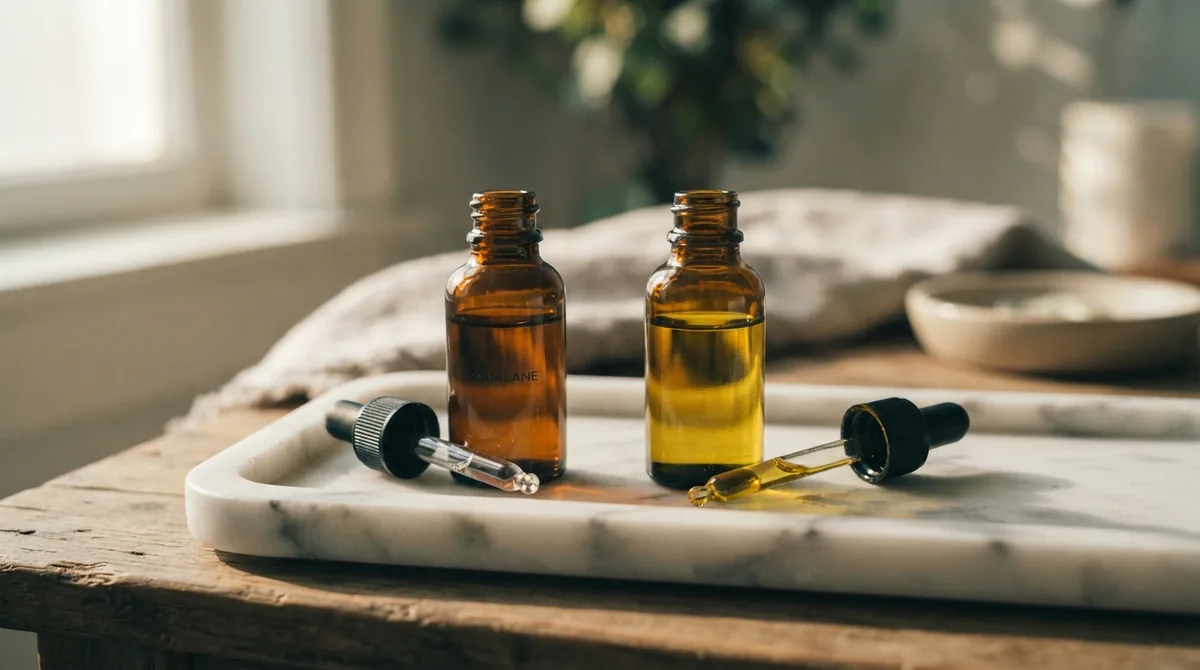
Squalane is one ingredient. Facial oils are a category. That’s the whole distinction.
Squalane (INCI: Squalane) is a hydrogenated, saturated version of squalene, a lipid your own sebum already contains. Because it’s saturated, it’s shelf-stable, odorless, and slips onto skin dry-touch rather than greasy. Most modern squalane on the K-beauty shelf is derived from sugarcane or olive, not shark liver. You can read the raw ingredient profile on INCI Decoder’s squalane page.
A “facial oil,” by contrast, might be jojoba (technically a wax ester, closest to sebum), rosehip (linoleic acid plus natural vitamin A and C), argan (oleic acid and vitamin E), camellia (a longtime Korean staple), or a blend. Each has its own fatty-acid balance, weight, and scent. That’s why “just use a facial oil” is bad advice — the wrong one can pill, clog, or feel heavy.
Skin-type fit
Which one suits oily or combination skin?
Squalane, almost always. Facial oils, only if you pick a linoleic-heavy one.
Oily and combination skin often produce sebum that’s already low in linoleic acid, which is one reason pores clog. Squalane is comedogenic-rated 0-1 in most references and doesn’t feed that imbalance. It sits light, absorbs fast, and disappears under sunscreen without a slick film.
If you prefer a plant oil, look for linoleic-forward options — rosehip, safflower, grapeseed, hemp seed. Skip the oleic-heavy ones (marula, argan, olive) unless your skin is genuinely dry, because oleic acid can feel occlusive on already-oily faces. Honest limit: no oil, squalane included, will “shrink pores” or fix congestion. It’s a barrier tool, not an active.
Routine placement
When and where do you actually use them in a routine?
After your water-based steps, before or with your moisturizer. In PM more than AM.
Here’s the order I’d give a friend for autumn:
| Step | AM | PM |
|---|---|---|
| Cleanse | gentle low-pH | oil cleanse + gentle |
| Toner / essence | hydrating | hydrating |
| Serum (actives) | vitamin C or niacinamide | retinal / BHA (as tolerated) |
| Squalane | 2-3 drops, optional | 3-5 drops |
| Moisturizer | lightweight | richer cream |
| Facial oil | usually skip | 2-3 drops on top, or mix into cream |
| SPF | non-negotiable | — |
A few real notes: squalane is fine under sunscreen if you use a small amount and wait a minute — anything heavier tends to disturb the SPF film. A true facial oil is better as the last step at night, or “sandwiched” into your moisturizer if your skin feels tight. Don’t apply oils before water-based hydrators; oils don’t push water in, they seal what’s there.
Squalane vs squalene
Is squalane the same as squalene?
No — one letter, big difference. Squalane is the stable one you want on your shelf.
Squalene (with an “e”) is the natural lipid in your sebum, but it oxidizes fast in a bottle, going rancid and potentially irritating. Squalane is squalene with the double bonds hydrogenated out, which makes it stable for years, colorless, and non-irritating. If a product lists “squalene” you may just be looking at a typo, but pure oxidized squalene isn’t something you want sitting on your face.
Autumn strategy
What does “the lipid autumn takes away” actually mean?
As humidity drops, your barrier lipids and water evaporate faster — replacing them, not just hydrating more, is the fall shift.
Summer routines lean on gel textures and humectants like glycerin and hyaluronic acid because the air is doing half the work. In autumn, low humidity accelerates transepidermal water loss, and skin lipids (ceramides, cholesterol, fatty acids, and yes, squalene) get depleted faster. That’s why a routine that felt perfect in August starts to feel tight in October.
The fix isn’t a heavier serum. It’s a lipid layer. Squalane is the lowest-effort way in — one ingredient, low risk, plays well with everything. A facial oil is the next step up when squalane plus moisturizer still isn’t holding through the day.
Buy vs skip
Who should buy squalane, and who should reach for a facial oil?
Most people should own squalane. Fewer people actually need a dedicated facial oil.
- Buy squalane if: you have oily, combination, sensitive, or acne-prone skin; you want one lipid that works AM and PM; you’re new to oils and don’t want to guess.
- Buy a facial oil if: your skin is genuinely dry or mature; you want vitamin E, linoleic acid, or antioxidants alongside the seal; you already have a stable routine and want a nighttime finisher.
- Skip both if: your current moisturizer already keeps skin comfortable all day and your barrier is calm. More lipid isn’t better lipid.
Curated, tested, and explained — so you can build a routine you’ll actually keep. That usually means one squalane on the shelf year-round, and maybe one seasonal facial oil for the coldest weeks.
Frequently Asked Questions
Q. Can I use squalane every day, morning and night?
A. Yes. Squalane is well-tolerated for most skin types and works in AM and PM. Use a small amount in the morning so it doesn’t disturb your SPF.
Q. Will squalane or facial oil break me out?
A. Squalane rates very low on comedogenic scales, so it’s usually safe even for acne-prone skin. Facial oils vary — oleic-heavy oils (marula, olive) are more likely to feel congesting than linoleic-heavy ones (rosehip, safflower).
Q. Should I put squalane before or after moisturizer?
A. Either works, but the common approach is right before moisturizer so the cream seals it in. Applying it after is fine too, especially at night, if your skin still feels tight.
Q. Is plant-derived squalane different from olive squalane?
A. Chemically, purified squalane is the same molecule regardless of source. Sugarcane- and olive-derived versions dominate today; shark-derived squalane is largely off the market in K-beauty.
Q. Can I mix squalane into my foundation or sunscreen?
A. A single drop can smooth a matte base, but too much thins SPF coverage. If you rely on your sunscreen for daily protection, keep the two steps separate.
The honest take: squalane and facial oils aren’t rivals — they’re different tools for the same autumn problem, which is barrier lipids leaving faster than they arrive. Start with squalane because it’s the lowest-risk, most flexible option. Add a facial oil only when your skin, not a trend, actually asks for it. This is educational, not medical advice, and individual results vary; if a product stings, pills, or breaks you out, listen to your skin before you listen to any routine — mine included.