Here is the short version: once I started treating summer barrier season as its own phase — not just “the oily months” — my sensitive skin stopped flaring in July. The shift was small. I stopped stacking actives, I hydrated more, and I moved exfoliation from a habit to a weekly decision.
Why the season matters
What is “summer barrier season” and why does it matter?
Summer is barrier season because heat, UV, sweat, and air-conditioning strip water from the stratum corneum faster than most routines can replace it. The skin still looks oily, so many of us over-cleanse and over-exfoliate, which thins the barrier further.
The barrier is the outermost layer of your skin — a mix of corneocytes and lipids (ceramides, cholesterol, fatty acids). When it is intact, water stays in and irritants stay out. The American Academy of Dermatology frames the summer job simply: cleanse gently, hydrate, protect from the sun.
In K-beauty terms, this is the season where “hydration first, actives second” becomes non-negotiable. If you take one thing from this post, take that.
Signs to watch for
What are the signs your barrier is struggling in heat?
The tell is not a breakout — it is a feeling. Tight cheeks after cleansing, a faint sting when sunscreen goes on, and a dull cast where you used to see bounce. These are early signs of summer barrier damage.

Other signals I trust: – Reactive flushing after a warm shower that fades slowly. – Sudden intolerance to a product you have used for months. – Rough patches on the cheeks or jawline, even while the T-zone feels oily. – Sunscreen pilling on areas that used to sit smooth.
If two or more of these show up in the same week, treat it as a barrier week, not a “new serum” week.
What to cut first
What should you cut first — is over-exfoliating in summer the real culprit?
Yes, for most sensitive types, over-exfoliating in summer is the first thing to cut. Daily acids, scrubs, and strong retinoids compound with UV and sweat, and the barrier does not get a chance to rebuild between insults.
Here is the rough triage I use on myself and share with friends:
| Step | Winter cadence | Summer cadence |
|---|---|---|
| Chemical exfoliant (AHA/BHA) | 3-4× per week | 1-2× per week, PM only |
| Retinoid | Nightly | Every 2-3 nights, buffered with cream |
| Vitamin C | AM daily | AM daily, lower % if stinging |
| Physical scrub | Occasional | Skip |
| Hydrating toner | Optional | Twice daily |
This is not a rule — it is a starting point. If your skin is calm and used to actives, you may not need to cut as much. If it is flaring, cut more.
The routine that helped
What does a calm summer barrier routine look like?
Short, boring, and repeatable. Five steps, chosen so nothing fights anything else.
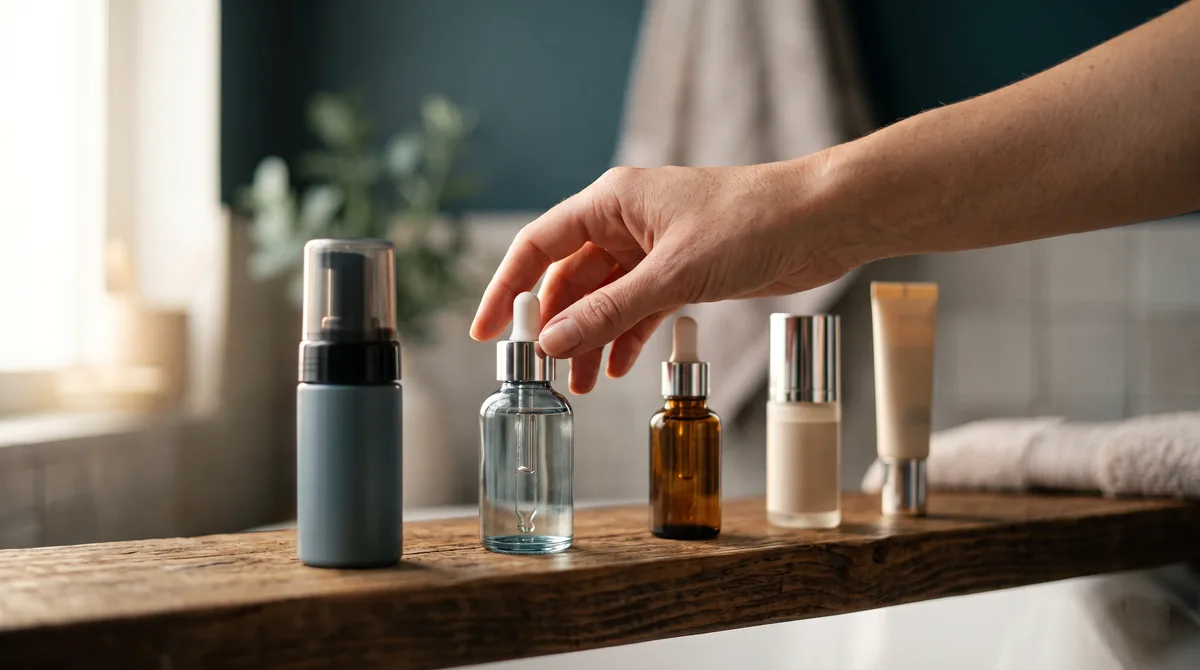
AM 1. Gentle low-pH cleanser (or just water if skin feels fragile). 2. Hydrating toner with glycerin — pat in two thin layers. 3. Barrier serum: panthenol, madecassoside, or a ceramide blend. 4. Light moisturizer with squalane or glycerin near the top of the INCI list. 5. Broad-spectrum SPF 50, reapplied at midday if you are outdoors.
PM 1. Oil or balm cleanser, then the same gentle cleanser. 2. Hydrating toner. 3. Barrier serum (same as AM) — or a low-dose exfoliant 1-2× per week instead. 4. A slightly richer cream if the AC in your bedroom runs cold.
Ingredient references (glycerin, panthenol, ceramides, madecassoside) can be looked up in the EU’s CosIng database if you want to verify what a brand claims.
Honest limit: this routine will not “fix” acne, melasma, or eczema — those need a dermatologist. It is a calm baseline, not a treatment plan.
Who this fits
Who should adjust — and who can stay the course?
Adjust if your skin is dry, sensitive, reactive, or newly on actives. Stay the course if you are oily-resilient, acne-prone in a way that improves with your current routine, and you are not seeing any of the signs above.
A quick fit guide:
- Best fit: dehydrated, sensitive, or combination skin that flares in heat.
- Also useful: anyone who over-exfoliated in the last month and needs a reset.
- Skip / modify: oily-tolerant skin that thrives on actives — you may only need to lighten textures and keep SPF strict.
Curated, tested, and explained — so you can build a routine you’ll actually keep.
Frequently Asked Questions
Q. How long does it take a damaged summer barrier to recover?
A. In my experience and per general dermatology guidance, mild cases settle in about 2-4 weeks of gentle care; deeper damage can take longer. If stinging or redness persists, see a dermatologist.
Q. Can I still use vitamin C and sunscreen together in summer?
A. Yes — vitamin C in the morning under SPF is a standard pairing. If you sting, drop the % or switch to a gentler derivative like sodium ascorbyl phosphate, and keep sunscreen non-negotiable.
Q. Is a 10-step Korean routine necessary for barrier care?
A. No. A five-step routine is enough for most people in summer. The "10 steps" idea is a menu, not a mandate — pick the steps your skin actually needs.
Q. Do I need a separate night cream in summer?
A. Only if your bedroom runs cold from air-conditioning or your skin feels tight overnight. Otherwise your daytime moisturizer is fine PM too.
Q. Are "clean beauty" or "chemical-free" claims meaningful for barrier care?
A. Not really. What matters is the INCI list and how your skin reacts. Glycerin, panthenol, and ceramides are well-studied barrier ingredients regardless of marketing labels.
The verdict: treating summer as barrier season is less about buying new products and more about subtracting the ones that overwork your skin in the heat. Hydrate more, exfoliate less, and keep SPF the one non-negotiable step. This is educational, not medical advice — if your skin is painful, broken, or not settling with gentle care, please see a professional rather than layering more products on top.